Photo: Tristram Kenton
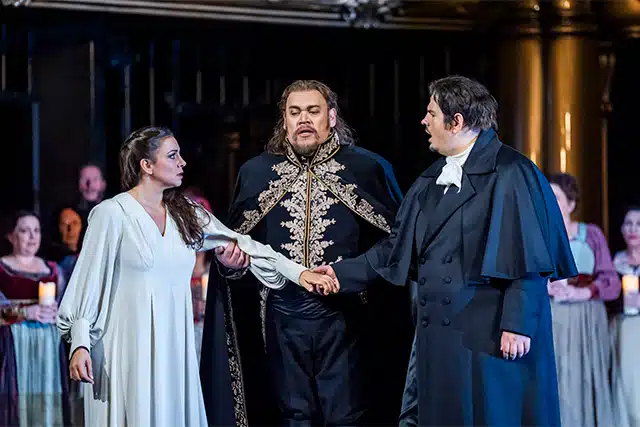
To be labelled ‘the premier Verdi baritone of your generation’ is the kind of line that can stick to a singer, whether they like it or not. Quinn Kelsey, returning to the Royal Ballet and Opera (RBO) after a nine year absence as Montfort in Verdi’s The Sicilian Vespers (performed in the original French), takes it with good humour but won’t let it define him. “I’m quite tickled by that”, he says, “but there’s no use getting carried away with labels. Opera’s a small business. Reputations are fragile. My job is to keep every role fresh, never let it stagnate, and put my best foot forward night after night. The moment you coast, you risk what you’ve built.”
That equilibrium owes something to home. He grew up in Hawai‘i, with what he calls “a certain relaxed tempo” baked into daily life. The easy-going exterior masks a quietly steely temperament. “Rehearsals go sideways, performances throw curveballs – nothing really gets to me. You stay cool, you keep focus and you solve the problem in the moment.” It reads less like bravado than habit: lower the temperature, keep the line.
London knows him chiefly through Verdi. He first sang at RBO as Germont (La traviata) and Count di Luna (Il trovatore); The Sicilian Vespers is his first return to the House since Trovatore in December 2016. There’s no drama behind the gap. “It was never a conscious break”, he says. “Sometimes the calendar just doesn’t line up.” Beyond Covent Garden, he debuted in the UK at English National Opera in The Pearl Fishers, returned there as Rigoletto, and gave a Wigmore Hall recital. Vespers feels like a resumption rather than a comeback.
Ask which Verdi role has taught him most and the reply comes fast. “It would have to be Rigoletto”, he says. “After about 150 performances I’ve really been able to become completely comfortable in the role – from cover to cover, dramatically and vocally. I understand my limits, my strengths, all the inner workings of my instrument.” He’s candid about the on-the-night realities. “What cheats, if you will, I could access in a split second of need – if I need a breath, or a swallow would help but there’s no time – I know myself so well I can beat that obstacle and carry on so the audience will never know.” He calls the jester a calling card now: “I could step on any stage and portray him whatever the production requires.”
Montfort is a different challenge. Kelsey doesn’t believe switching language rewrites a character’s centre of gravity, but he’s attentive to how it alters the route. “I don’t think language changes the dramatic spine, but it definitely changes your path to it”, he says. “Diction, vowel shape, the way you release a phrase – French and Italian ask different things of you.” He has lived with the part in both tongues – Monforte in Italian last season in Zurich, the original French earlier in his career in Frankfurt – and circling back now has felt healthy. “Let the text lead, whatever the language”, he says, “and keep the technique honest.”
He reads Montfort across Verdi’s gallery of conflicted men. “There’s a bit of Germont in him, that rigidity that’s really love in disguise”, he says. “You get di Luna’s doubt, Boccanegra’s battered nobility, even flashes of Macbeth’s private unravelling.” The baritone’s first task is to establish the iron of office quickly, so the opera can pivot to the human. For him, the hinge is the Act III aria, ‘Au sein de la puissance / In the bosom of opulence’ – the point where the fatherly nature in Montfort asserts itself. The trick, he says, is balance: “Keep the authority intact while letting a more vulnerable man show through.”
None of this, he’s quick to add, happened by chance. He talks about pacing as a plan rather than a slogan – not choosing roles only for character, but sequencing them for scope and timing. Early on, a lighter colour and flexibility made Mozart and bel canto the right terrain; heavier Verdi arrived when nature and experience aligned. With that base in place, the work deepens. You can return to roles and “delve deeper” with a sound that is yours, not borrowed. The reward is longevity: “you open the door to Rigoletto, Boccanegra and Macbeth in a way that keeps the instrument safe.”
He isn’t a Verdi absolutist either. Scarpia has entered the mix and, for Kelsey, doesn’t sit in opposition to Verdi – more that it’s built on the same foundations. “I definitely apply all I’ve learned from Verdi and bel canto towards Baron Scarpia. The framework is still the same”, he says. “Puccini, in my opinion, doesn’t want anything so different from Verdi. They each have certain qualities that define them – a difference of bite or colour in the voice perhaps. But I’ve been able to carry over much of what I do vocally in Verdi to Scarpia quite easily.” He adds: “I’d consider Verdi to be formal in his writing – structured – even in some of his operas’ most heated moments. Whereas Puccini is very much the contemporary thereof, and it’s obvious he built on so much of what Verdi established.”
Look ahead and the wishlist is revealing. “Iago is a ‘not yet’”, he says with a smile. “Nabucco can wait.” Jack Rance (La fanciulla del West) beckons; Tonio (Pagliacci) has opened a new door, with Alfio (Cavalleria rusticana) to follow next month. He wants more Russian – he has tasted Yeletsky and Onegin in excerpts – and Don Carlo in La forza del destino is already pencilled in, in a few years time. “Gérard in Andrea Chénier is high on the list”, he says. And Wagner? He’s neither chasing nor shutting it down. “I understudied Donner twice; Wolfram’s Abendstern was in my young-artist audition book. But Wagner lovers often expect a particular colour. If it’s meant to be, it’ll happen.”
Threaded through the talk about his craft is a line about advocacy that feels unforced. “Opera has stood the test of time”, he says. “Imagine those first audiences hearing it all come together – words, orchestra, voice – not just sound but theatre. That shock, that elevation. How could we not want to preserve it for future operagoers?!” It reads like a quiet manifesto: sing it well, keep the standards high and pass it on in better shape than you found it.
And so to Covent Garden, where Montfort returns in French – iron and tenderness in the same breath. Kelsey arrives with the serenity of Hawai‘i in the bloodstream, the discipline of a long-game technician, and the instincts of someone who has lived inside Verdi’s contradictions long enough to know where the seams are. Labels can look after themselves. The work is nightly: keep it fresh; don’t let it stagnate; hold enough in reserve to tell the truth when the pit is at full roar. “You put your best foot forward”, he says. “It’s not mystique. It’s a way of doing the job that keeps audiences coming back – and keeps the music honest.”
• The Sicilian Vespers runs until 6 October. Details at rbo.org.uk